
When Is It Time for Knee Replacement Surgery? 7 Warning Signs
Persistent knee pain? Discover the 7 medically validated signs that indicate joint replacement might be necessary — and why Oxford Hospital leads in robotic knee surgery.
Knee pain that wakes you at night, stops you climbing stairs, and ruins your morning walk is no longer "just age". It is a treatable medical condition — and Oxford Hospital Jalandhar offers Punjab's most advanced knee replacement surgery with 95%+ success rate.
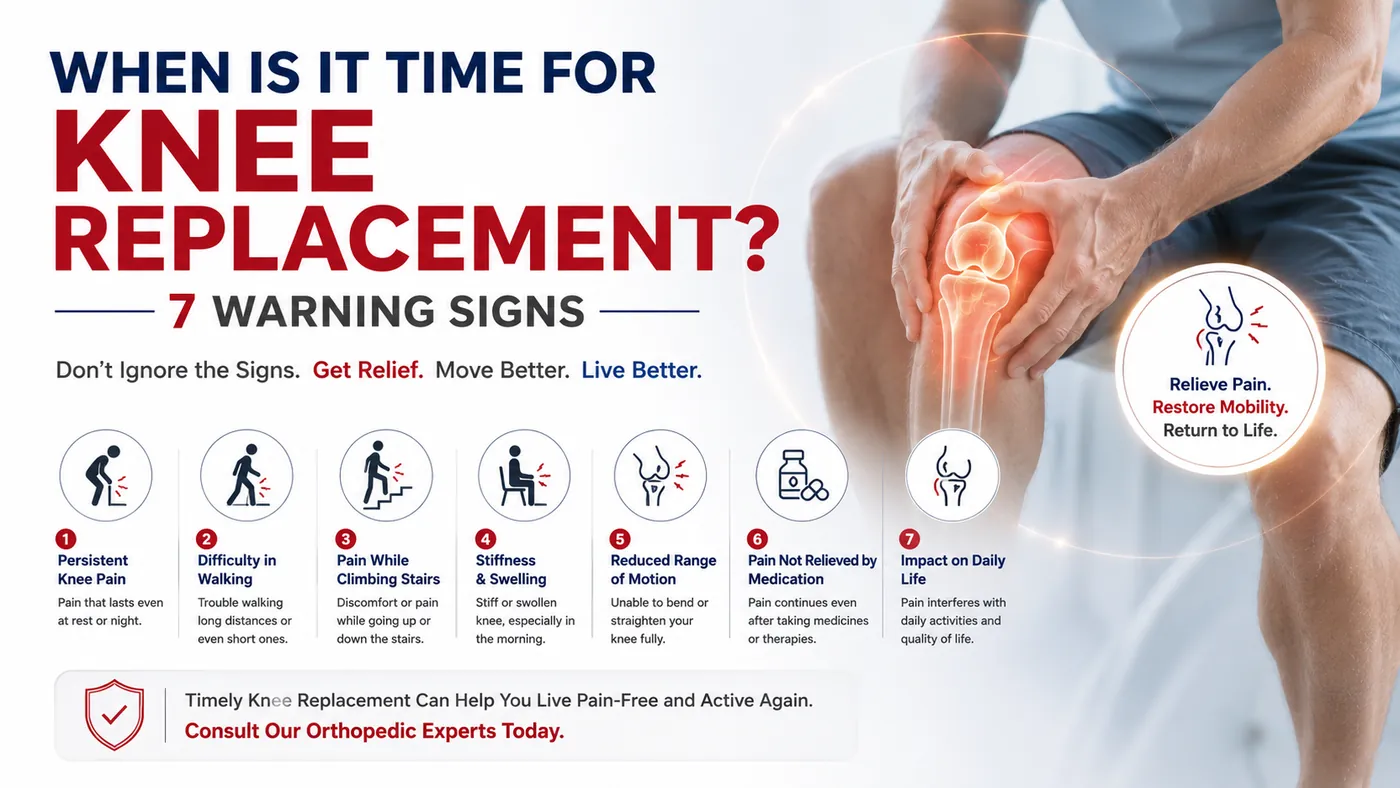
7 Warning Signs You May Need Knee Replacement
- Knee pain that persists for 6+ months despite medication and physiotherapy.
- Pain at rest — even sitting or sleeping.
- Visible deformity — bowing inward (varus) or outward (valgus).
- Stiffness that limits bending below 90°.
- Grinding or grating sensation (crepitus) on movement.
- Inability to walk more than 200 metres without stopping.
- X-ray shows bone-on-bone contact with loss of cartilage.
Knee Replacement Options at Oxford Hospital
- Total Knee Replacement (TKR) — both knee compartments
- Partial / Unicondylar Knee Replacement — less invasive
- Robotic-assisted knee replacement — sub-millimetre alignment
- High-flex implants — designed for Indian sitting postures
- Bilateral simultaneous TKR — both knees in one surgery
Cost in Jalandhar (2026)
Single knee replacement: ₹1.8L–₹2.8L. Bilateral: ₹3.2L–₹4.5L. Robotic option adds ₹40k–₹60k. Cashless under PMJAY, CGHS, ECHS, ESI and major insurers.
Recovery Timeline
Day 1: walk with walker. Day 3: discharge. Week 2: stitches out. Week 6: stairs without support. Month 3: full daily activity. Month 6: optimal function.
Book a knee assessment with Oxford Hospital orthopedic team. Call +91 98550 00028.
Disclaimer: This article is for informational purposes only and not a substitute for medical advice. Consult a healthcare professional for diagnosis, treatment, or concerns. Call us at +91 98550 00028 or Visit Oxford Hospital, Jalandhar.
Frequently Asked Questions
When is knee replacement actually necessary?
It is usually considered when pain persists beyond six months despite medication and physiotherapy, X-rays show bone-on-bone arthritis, walking even short distances becomes difficult, pain disturbs sleep, or daily activities are severely limited. Surgery is a decision about quality of life, taken once non-surgical options have genuinely been tried.
How much does knee replacement cost in Jalandhar?
Single knee replacement at Oxford Hospital is ₹1.8 Lakh to ₹2.8 Lakh. Bilateral replacement in one sitting is ₹3.2 Lakh to ₹4.5 Lakh. Robotic-assisted surgery adds ₹40,000 to ₹60,000. All are cashless under PMJAY, CGHS, ECHS and major insurers.
Can both knees be replaced at the same time?
For medically suitable patients, yes. Bilateral replacement in a single anaesthesia event means one hospital stay and around six weeks of recovery instead of roughly twelve for staged surgery. Suitability depends on cardiac and general fitness, which is assessed before the decision is made.
Will I be able to sit cross-legged after knee replacement?
That is exactly why implant choice matters here. Standard Western implants often cap flexion near 110 degrees, which makes floor-sitting difficult. Oxford Hospital uses high-flex designs allowing 130 degrees or more, so patients can generally return to cross-legged sitting and floor-level activity, guided by their surgeon and rehabilitation progress.
How long does a knee implant last?
Modern implants show around 95% survival at five years, and most continue to function well beyond fifteen years. Longevity depends heavily on surgical alignment, body weight, activity level and adherence to rehabilitation.
What is recovery like after knee replacement?
Most patients stand and take assisted steps on the first day after surgery. Hospital stay is typically three to five days. Walking aids are usually needed for two to six weeks, and structured physiotherapy continues for around three months. Committing to rehabilitation is the strongest predictor of a good outcome.
Are there alternatives to knee replacement?
Yes, and they should be tried first in most cases: weight reduction, structured physiotherapy to strengthen the quadriceps, anti-inflammatory medication, intra-articular injections, and for younger patients with localised damage, arthroscopy or partial replacement. Surgery is appropriate when these no longer control symptoms.
Could not find what you are looking for?
Request a Callback
Helpline
+91 98550 00028
Available
24 / 7 — All Days
Location
305 Lajpat Nagar, Near Nakodar Chowk, Jalandhar, Punjab 144001
support@oxfordhospital.in